
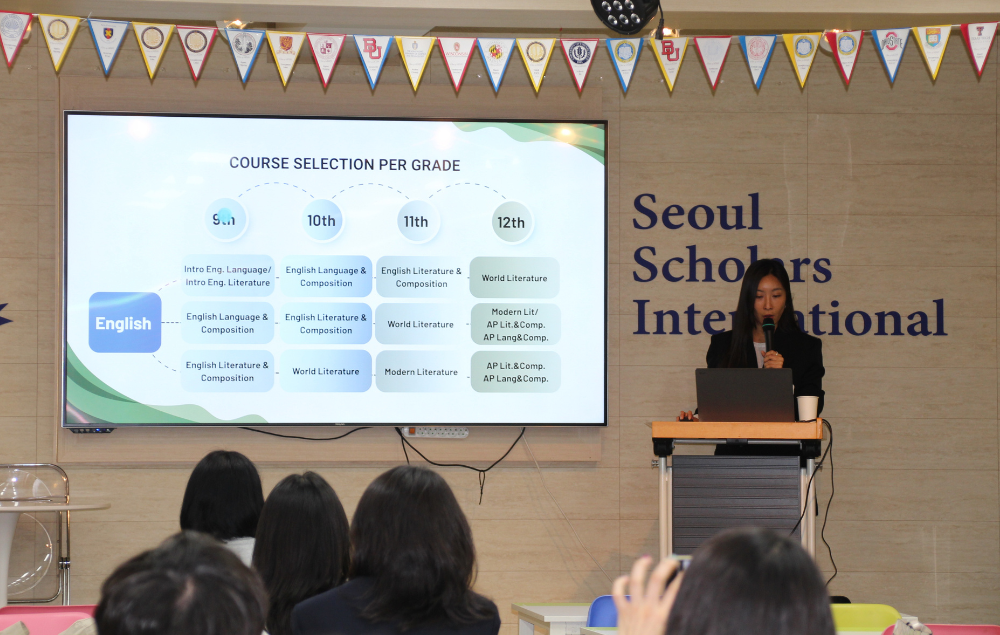
On October 20, 2026, SSI hosted the 4-Year Roadmap Seminar for parents led by Ms. Remi Lee, the seminar explained how students should plan their academics from Year 7 to Year 11, covering course selection, Advanced Placement (AP) and AP Capstone, GPA management, and college preparation. It also presented real university admission case studies from New York University (NYU), Johns Hopkins University, and the Hong Kong University of Science and Technology (HKUST).
Seminar at a Glance
| Date & Time | October 20, 2026 (Tuesday) |
| Location | SSI Daechi |
| Audience | SSI parents |
| Presenter | Ms. Remi Lee, 7th~9th grade counselor |
| Sessions | 1) Year-by-year roadmap (Years 7–11) 2) Course pathways, AP and AP Capstone 3) GPA: weighted vs. unweighted 4) Three admission case studies 5) Parent Q&A |
| Case Studies | NYU (Dentistry), Johns Hopkins University (Sociology), HKUST (Quantitative Finance) |
How should students prepare for U.S. college admissions each year?
The seminar introduced a year-by-year academic and college preparation roadmap, highlighting how students’ priorities evolve throughout their academic journey:
- Years 7–8: Develop effective study habits and explore academic interests.
- Year 9: Establish more structured academic plans and understand the importance of GPA management.
- Year 10: Explore potential majors and prepare for standardized tests such as the SAT and TOEFL.
- Year 11: Refine academic goals and prepare for university applications.
Through this roadmap, parents gained a clearer understanding of why college preparation should be a continuous process tailored to each student’s academic development.
How should students choose AP courses?
SSI’s year-by-year course pathways
The seminar introduced SSI’s curriculum and year-by-year course selection pathways. SSI offers flexible academic pathways based on students’ readiness and future academic goals. Parents learned about course sequences in English, mathematics, science, social sciences, and computer science, including how students can progress toward AP-level coursework.
AP and AP Capstone: quality over quantity
The presentation also covered Advanced Placement (AP) and AP Capstone, explaining their role in developing advanced academic skills and preparing students for university-level learning. Rather than focusing solely on the number of AP courses taken, the session highlighted the importance of selecting courses that align with students’ academic readiness, prerequisite requirements, and intended fields of study.
How is GPA calculated, and why does it matter for college admissions?
Another key topic was Grade Point Average (GPA) and its role in evaluating academic performance. The seminar explained how GPA is calculated using course grades and credits, as well as the differences between weighted and unweighted GPA:
- Weighted GPA: accounts for the difficulty of advanced courses, such as AP classes.
- Unweighted GPA: uses a consistent grading scale regardless of course difficulty.
This discussion helped parents understand why both academic performance and course rigor are important considerations in college admissions.
Which university admission case studies were presented?
A highlight of the seminar was the presentation of three university admission case studies, connecting academic planning strategies with real student outcomes:
- New York University (NYU) — Dentistry
- Johns Hopkins University — Sociology
- HKUST — BSc in Quantitative Finance
These examples introduced parents to different academic pathways and showed how university preparation can vary depending on students’ interests, intended majors, and long-term goals, and how course selection, academic performance, and long-term planning relate to each student’s admission journey.
What did parents say about the seminar?
Feedback from the post-seminar parent survey was positive. Parents highlighted the year-by-year course and testing timelines, explanations of AP and AP Capstone, and real university admission case studies as particularly helpful.
“Having been familiar with the Korean education system only, it was helpful to see the bigger picture.”
— Parent, post-seminar survey
“It was a great opportunity to think about a four-year plan.”
— Parent, post-seminar survey
How does SSI help families plan for the next four years?
The 4-Year Roadmap Seminar provided parents with a comprehensive overview of SSI’s academic curriculum, GPA system, and college preparation framework.
SSI remains committed to helping students establish academic goals, make informed course selections, and prepare for university admissions through structured, individualized academic guidance. Learn more about SSI’s Academic & College Counseling, or visit the Admission page to learn about joining SSI.
Frequently Asked Questions (FAQ)
When should students begin preparing for U.S. college admissions?
SSI introduces academic planning from Years 7–8, beginning with study habits and academic exploration. From Year 9 onward, students gradually focus on course selection, GPA management, potential majors, and standardized test preparation. See Academic & College Counseling for details.
Is taking more AP courses always better for college admissions?
Not necessarily. While AP courses demonstrate engagement with advanced academic content, students should consider their academic readiness, course prerequisites, and intended majors when selecting AP subjects.
What is the difference between Weighted and Unweighted GPA?
Weighted GPA considers course difficulty, assigning additional weight to advanced courses such as AP classes. Unweighted GPA calculates grades using the same scale regardless of course difficulty.
Where can I find more SSI university admission results?
Explore additional university admission results and student achievements on the SSI College Admissions Results page.